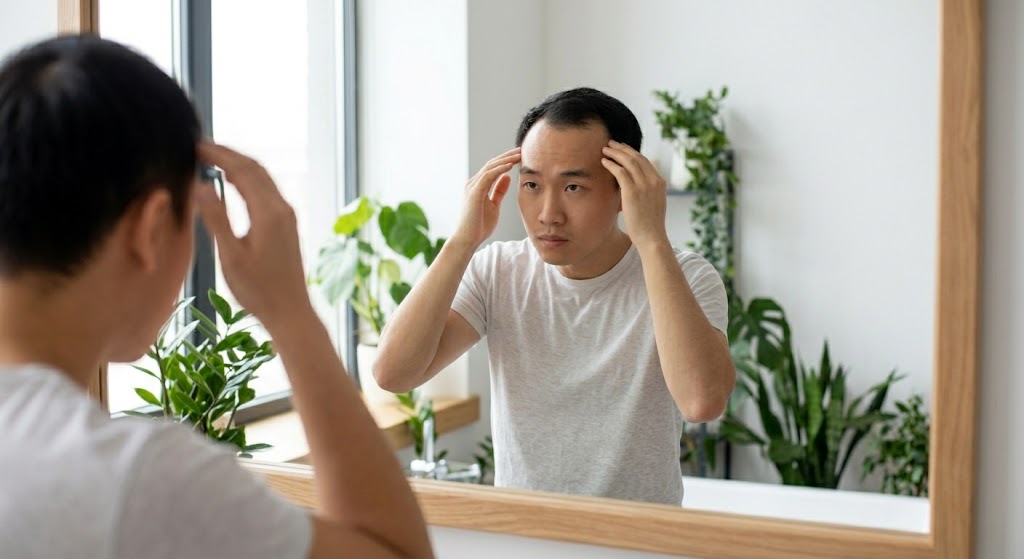
Many people assume hair loss is something that happens later in life, but a receding hairline often begins much earlier. A large number of men notice changes to their hairline during their 20s or 30s, sometimes long before significant thinning or bald spots develop.
Early hairline recession does not automatically mean complete baldness is inevitable. Understanding the causes behind a receding hairline can help with taking action sooner, when treatment options are often most effective.
At PRP in Seattle, licensed aestheticians work with patients experiencing early hair loss to evaluate the pattern of change and discuss the most appropriate next steps.
What Does a Receding Hairline Look Like?
A receding hairline does not always present as a sudden or dramatic change. For most men, the shift is gradual and easy to overlook in the early stages. Knowing what to look for helps catch the process before it advances.
M-Shaped Hairline Development
One of the most recognizable patterns is the formation of an M-shaped hairline. The hair at the temples begins to pull back on both sides while the center of the hairline remains relatively forward, creating a distinctive shape at the front of the scalp.
Temple Recession
Recession often starts at the temples before spreading to other areas. Men in their 20s may first notice the corners of their hairline becoming less defined or the area above the temples appearing thinner than it previously was.
Increased Forehead Visibility
As the hairline moves back, the forehead appears larger. This change is gradual and can be hard to notice without comparing photos taken months or years apart.
Uneven Hairline Changes
Recession does not always progress evenly. One side may change faster than the other, resulting in an asymmetrical hairline that looks different from previous years.
Thinning Around the Hairline
The hairs along the hairline may become finer and shorter before they disappear entirely. This hairline thinning is often one of the earliest indicators of androgenetic alopecia and can precede visible recession by months or longer.
Is It Normal for a Hairline to Change in Your 20s?
Yes, hairline changes in the 20s are common and do not always indicate a problem. The key is understanding the difference between a natural hairline evolution and the beginning of hair loss.
Mature Hairline vs. Receding Hairline
A mature hairline is a normal development that typically occurs in a person’s late teens or early 20s. It involves a slight, even recession of the hairline from the juvenile position, usually by about half an inch. This process is symmetric, gradual, and does not continue to progress. A receding hairline, by contrast, continues to move back over time, often unevenly, and is accompanied by thinning along the temples or crown.
When Changes May Signal Hair Loss?
If the hairline continues to recede beyond the mature hairline stage, if shedding increases noticeably, or if the hair at the temples and crown begins to thin, these are signs that early hair loss treatment in men may be worth exploring. A scalp evaluation by a qualified provider can help distinguish between normal maturation and androgenetic alopecia.
The Most Common Cause: Male Pattern Hair Loss
Male pattern hair loss, also called androgenetic alopecia, is by far the most common reason men experience a receding hairline in their 20s and 30s. It accounts for the majority of early hair loss in men and follows a well-documented progression that begins at the temples and crown.
The Role of Genetics
Androgenetic alopecia is strongly hereditary. Men who have fathers, grandfathers, or maternal relatives with significant hair loss carry a higher genetic likelihood of experiencing it themselves. The condition can be inherited from either side of the family, which means family history on both the mother’s and father’s side is relevant.
DHT Sensitivity and Follicle Miniaturization
The primary biological driver of male pattern hair loss is sensitivity to dihydrotestosterone, commonly known as DHT. DHT is a hormone derived from testosterone. In men who are genetically predisposed, DHT binds to receptors in hair follicles and gradually causes them to shrink over successive growth cycles. This process, called follicle miniaturization, results in progressively thinner, shorter hairs until the follicle stops producing visible hair altogether.
The earlier this process begins, the more important it becomes to address it. Follicles that are miniaturizing but still active can often be supported with treatment. Follicles that have been inactive for an extended period are significantly harder to restore.
Can Stress Cause a Receding Hairline?
Stress is a commonly cited cause of hair loss, and there is a real connection, though it operates differently from male pattern hair loss.
Telogen Effluvium
High levels of physical or emotional stress can push large numbers of hair follicles into the resting phase of the growth cycle simultaneously. This condition is called telogen effluvium. The result is increased shedding, typically occurring two to three months after the triggering event. Telogen effluvium tends to cause diffuse thinning across the scalp rather than a receding hairline specifically.
Stress as a Contributing Factor
While stress alone does not typically cause the M-shaped recession associated with androgenetic alopecia, it can accelerate hair loss in men who are already genetically predisposed. Chronic stress, poor sleep, and inadequate recovery can all worsen the overall health of hair follicles and contribute to faster progression.
Managing stress through regular physical activity, consistent sleep schedules, and addressing underlying sources of chronic pressure supports overall hair health, but it is not a substitute for targeted hair loss treatment when genetic factors are involved.
Hormonal Factors That May Affect a Hairline
Beyond DHT, other hormonal changes can contribute to hair loss or accelerate a receding hairline.
Testosterone and DHT Conversion
The enzyme 5-alpha reductase converts testosterone into DHT. Men with higher activity of this enzyme produce more DHT, which increases the impact on sensitive follicles. This is why some treatments for hair loss focus on reducing DHT levels or blocking its effects at the follicle level.
Thyroid Disorders
Both an underactive thyroid (hypothyroidism) and an overactive thyroid (hyperthyroidism) can cause diffuse hair loss across the scalp. If a receding hairline is accompanied by fatigue, weight changes, or other systemic symptoms, a thyroid evaluation may be appropriate.
Age-Related Hormonal Shifts
As men age through their 20s and 30s, hormone levels shift in ways that can influence the rate of hair follicle miniaturization. These changes are gradual but cumulative, which is why men who begin noticing hairline recession in their mid-20s often see faster progression by their mid-30s if no intervention is made.
Other Possible Causes of Hairline Recession
While male pattern hair loss accounts for the majority of receding hairlines, several other factors can contribute to or accelerate the process.
- Nutritional Deficiencies: Low levels of iron, zinc, biotin, vitamin D, and protein can impair hair growth and weaken existing strands, making follicles more vulnerable to miniaturization.
- Rapid Weight Loss: Crash dieting or significant rapid weight loss can trigger telogen effluvium and accelerate hair shedding, sometimes for months after the initial loss.
- Smoking: Research suggests smoking can impair scalp circulation and increase oxidative stress, both of which may worsen hair follicle health and accelerate loss.
- Chronic Illness: Certain systemic conditions, including autoimmune disorders, anemia, and inflammatory diseases, can contribute to hair loss.
- Certain Medications: Some medications used to treat blood pressure, depression, acne, or other conditions list hair loss as a side effect. A review of current medications with a provider can help identify whether this may be a contributing factor.
- Hairstyling Habits: Tight hairstyles that pull consistently at the hairline, such as tight ponytails, braids, or man buns worn regularly, can cause traction alopecia. This is a mechanical form of hair loss that develops gradually along the hairline due to repeated tension on the follicles.
Why Early Treatment Matters?
For men dealing with a receding hairline in their 20s or a receding hairline in their 30s, early intervention consistently produces better outcomes than waiting. This is one of the most clinically important points in hair loss prevention.
Hair follicles that are weakening but still active can often be supported with non-surgical treatments. Once a follicle has been inactive for a prolonged period, the window for effective restoration narrows considerably. Scar tissue may form around dormant follicles, reducing their responsiveness to regenerative therapies.
Early treatment for a receding hairline is not about addressing a cosmetic concern prematurely. It is about preserving the follicles that are currently present before they become permanently inactive. The earlier treatment begins, the more options remain available, and the more hair there is to maintain.
Treatment Options for a Receding Hairline
Several non-surgical and surgical options are available for men dealing with early hair loss and hairline recession. The right approach depends on the degree of recession, the pattern of thinning, overall scalp health, and individual goals.
PRP Hair Restoration
Platelet-Rich Plasma (PRP) hair restoration is a non-surgical receding hairline treatment in Seattle that uses growth factors derived from the patient’s own blood to support weakening follicles. Blood is drawn, processed in a centrifuge to concentrate the platelets, and injected into areas of thinning or recession. The growth factors in PRP stimulate follicle activity, improve scalp circulation, and may help slow the progression of hairline recession in candidates with viable follicles.
PRF Hair Restoration
Platelet-Rich Fibrin (PRF) is a more advanced preparation similar to PRP but with a slower release of growth factors. The fibrin matrix in PRF allows for a more sustained delivery of regenerative components to the scalp. PRF is often recommended for patients who want a longer-lasting treatment effect from a single session or as a complement to PRP.
Low-Dose Minoxidil
Minoxidil is one of the most researched topical and oral medications for hair loss. At low doses, it can help extend the growth phase of hair follicles and may support hairline density over time. It is most effective when used consistently and in combination with other treatments such as PRP or PRF.
Exosome Hair Restoration
Exosome therapy is an emerging regenerative approach that uses cell-derived signaling particles to stimulate follicle activity. Exosomes contain growth factors, proteins, and genetic material that may promote hair regrowth at the follicle level. This option is typically considered for patients seeking a more advanced biological approach or those who have not responded fully to PRP alone.
Hair Transplant Surgery
For men with more advanced recession, hair transplant surgery relocates follicles from a donor area (typically the back or sides of the scalp) to areas of significant loss. Transplant surgery is most appropriate when non-surgical options are no longer sufficient to address the degree of hairline recession. Many patients benefit from combining transplant surgery with PRP or PRF to support graft survival and overall scalp health.
Can PRP Help a Receding Hairline?
PRP is one of the most widely used non-surgical treatments for early hairline recession, and for good reason. It works best in specific circumstances, and understanding those helps set realistic expectations.
Ideal Candidates for PRP
Men who see the strongest results from PRP for a receding hairline tend to be those in the earlier stages of hair loss, where follicles are miniaturizing but still active. PRP is not designed to restore a hairline that has been fully absent for many years, but it can be highly effective at stabilizing an actively receding hairline and maintaining the density of existing hair.
Hairline Stabilization and Follicle Support
The growth factors delivered through PRP scalp injections signal follicles to shift back toward the active growth phase. Over a series of treatments, many patients notice a reduction in shedding, improved hair thickness, and a slower rate of recession. The goal with PRP at the hairline is often to preserve what is present rather than to dramatically regenerate lost ground, though some patients do experience visible regrowth in areas of early thinning.
Combination Approaches
PRP can be used alongside low-dose minoxidil, PRF, or exosome therapy for a more comprehensive treatment plan. Combination approaches are often recommended for patients with a strong family history of hair loss or those whose recession has progressed into the moderate range.
Internal link: Learn more about PRP for Thinning Hair in Seattle.
When Should a Hair Restoration Specialist Be Consulted?
Not every hairline change requires immediate treatment, but certain signs suggest that a professional evaluation is worthwhile. Waiting too long can reduce the effectiveness of available options.
- The hairline has visibly moved back from where it was one to two years ago
- There is a noticeable family history of significant hair loss on either side of the family
- The temples or crown are thinning alongside the hairline
- Daily shedding has increased and does not appear to be returning to normal after several months
- There is a desire to take a proactive approach to hair loss prevention before recession becomes more advanced
A consultation with a hair loss specialist in Seattle does not commit anyone to a particular treatment. It is an evaluation that clarifies what is happening, why it may be occurring, and what options are most appropriate for the specific pattern of change.
How Hair Loss Is Evaluated?
A thorough evaluation is the foundation of any effective hair restoration plan. At PRP in Seattle, the assessment process includes several components that together provide a clear picture of the degree of loss and the most appropriate treatment path.
Hair History
The provider will ask about when changes to the hairline were first noticed, how quickly the recession has progressed, any relevant medical history, current medications, and family history of hair loss. This context helps determine whether the cause is primarily genetic, hormonal, nutritional, or a combination of factors.
Scalp Assessment
A close examination of the scalp allows the provider to assess follicle density, the health of the skin and existing follicles, and any signs of inflammation or scarring that could affect treatment options.
Pattern Analysis
Understanding the specific pattern of recession, whether it follows a classic androgenetic pattern, a diffuse thinning pattern, or a localized change, guides treatment planning. The Norwood scale is commonly used to categorize the stage of male pattern hair loss and helps establish a baseline for tracking progress over time.
Treatment Planning
Once the evaluation is complete, the provider develops a customized plan based on the patient’s goals, the degree of recession, scalp health findings, and which treatments are most likely to produce meaningful results. There is no single protocol that fits every case of early hair loss.
Receding Hairline Treatment in Seattle
For men in Seattle seeking receding hairline treatment, PRP in Seattle provides non-surgical hair restoration options backed by a team of board-certified providers and skilled licensed aestheticians. The practice focuses on early intervention, which consistently yields better outcomes than waiting for hair loss to become advanced.
Hair loss treatment in Seattle is personalized from the first consultation. Rather than applying a standard protocol, providers assess the specific pattern of recession, the health of existing follicles, and the patient’s goals before recommending a treatment plan. Available options include PRP, PRF, exosome therapy, low-dose minoxidil, and hair transplant surgery for cases that have progressed beyond what non-surgical options can fully address.
Men dealing with a receding hairline in their 20s or 30s have the most to gain from acting early. Hair restoration in Seattle through PRP in Seattle is designed to meet patients at the stage of loss they are currently experiencing and build a plan that makes sense for where they are now and where they want to be.
Schedule a Hairline Consultation in Seattle
Noticing a receding hairline is the right time to find out what is causing it and what can be done. PRP in Seattle offers hairline evaluations for men experiencing early hair loss, with treatment plans tailored to the individual pattern and stage of recession.
Call (206) 279-2112 or submit an online consultation request to schedule an appointment at PRP in Seattle today.