PRP for hair restoration Seattle has become one of the most sought-after non-surgical treatments for people dealing with thinning hair. The treatment uses your own blood platelets to stimulate weakened hair follicles, encouraging them to produce thicker, healthier hair growth without surgery, medications, or downtime.
At our Seattle practice, board-certified surgeons and licensed aestheticians collaborate on every PRP treatment. We look at your specific hair loss pattern, your goals, and your overall health before building a plan. Your treatment is shaped around you because generic approaches don’t deliver meaningful results.
This guide covers how PRP hair restoration works, who benefits most from treatment, what appointments involve, recovery expectations, and how PRP compares against other hair restoration options available today.
By the end, you will have a solid understanding of whether PRP hair restoration Seattle is the right fit for your hair concerns and your lifestyle.
What Is PRP Hairline Restoration?
PRP (platelet-rich plasma) is a treatment that uses your own blood to signal your hair follicles to work harder.
Here’s what actually happens. A doctor takes a small blood sample from your arm, just like a regular blood test. That sample goes into a machine that spins it really fast. This spinning separates your blood into different parts. The platelets, which are tiny pieces of your blood that help your body heal, get concentrated into a thick, nutrient-rich liquid. That liquid is your PRP.
Those platelets are loaded with growth factors. Growth factors are your body’s way of sending signals for repair and rebuilding. When a doctor injects PRP into your scalp, those growth factors start talking to your hair follicles. They’re essentially saying, “Wake up and get to work.” The follicles respond by becoming more active, increasing blood supply, and producing thicker, healthier hair.
What Causes Hairline Recession?
Understanding why your receding hairline treatment Seattle for some people and why it has limitations for others.
Genetics is the primary driver
About 50 million American men and 30 million women experience pattern baldness. If your parents or grandparents had hair loss, you likely inherited the genetic sensitivity to DHT (dihydrotestosterone), a hormone that causes hair follicles to shrink. This isn’t something you did wrong. It’s written into your DNA.
Hormonal changes amplify the problem
DHT doesn’t affect everyone equally. Some people’s follicles are genetically programmed to be sensitive to this hormone. As you age, DHT levels can increase, accelerating hair loss. This is why more than 50 percent of men will experience some type of hair loss after 50.
Stress and inflammation create secondary damage
Chronic stress elevates cortisol levels, which can prematurely push hair follicles into a resting phase. Inflammation in the scalp reduces blood flow to follicles, starving them of nutrients. Over time, this combination weakens even follicles that aren’t genetically sensitive to DHT.
Aging changes your scalp environment
As you get older, blood circulation to your scalp naturally decreases. Your scalp produces less sebum (the natural oil that protects hair). Collagen production slows down. All of these changes make your follicles more vulnerable to miniaturization.
Traction and styling damage
If you wear your hair pulled back tightly, use harsh styling products, or have a history of aggressive hair treatments, you can mechanically damage your hair follicles. This type of hair loss is called traction alopecia.
Female-pattern hair loss follows a different pattern
Women typically experience diffuse thinning across the entire scalp rather than a receding hairline. Hormonal fluctuations during menopause, thyroid issues, and nutritional deficiencies can trigger or accelerate female hair loss.
How PRP Works for Hairline Restoration?
PRP scalp treatment Seattle works by using components from your own blood to support hair follicles and overall hair health.
Step 1: Blood collection and processing
The treatment starts with a small blood draw, similar to routine lab work. The blood is placed in a centrifuge, which separates and concentrates the platelet-rich plasma.
Step 2: PRP is injected into the scalp
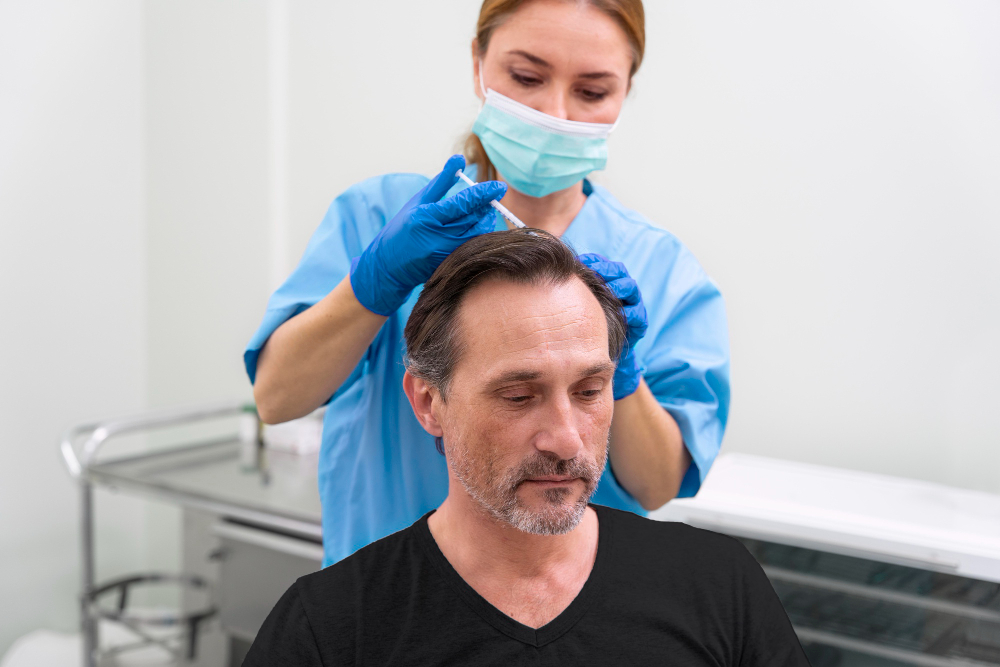
The prepared PRP is injected into areas of thinning hair. Platelets release growth factors that help support blood flow, follicle activity, and the scalp environment.
Step 3: Follicle support and hair growth
Hair grows in cycles, and PRP for thinning hairline often spends less time in the active growth phase. PRP aims to support follicles that are still functioning, helping improve hair thickness, density, and overall growth quality over time.
Step 4: Scalp health and structural support
Natural hair restoration Seattle may also support collagen production and scalp health, creating a healthier environment for hair growth.
Who Is a Good Candidate for PRP Hair Restoration?
PRP hair restoration works best for people in the early to moderate stages of hair thinning who still have active hair growth in the treatment area.
You may be a good candidate if you:
- Have a receding hairline or thinning hair, but are not completely bald in those areas
- Are you dealing with hair loss related to genetics, aging, or hormonal changes
- Want a non-surgical hair restoration Seattle treatment option
- Are comfortable with a treatment plan that may involve multiple sessions and maintenance care
PRP therapy for hair regrowth may be less suitable if you:
- Have had complete hair loss in an area for many years
- Have an active scalp condition or infection that needs treatment first
- Have certain medical conditions or medications that may affect candidacy
- Are you expecting fast or dramatic changes
What to Expect During PRP Hairline Treatment?
Consultation:
Your first visit is usually an evaluation. Your provider will look at your hair loss pattern, review your medical history, and discuss your goals and treatment options.
Treatment Day:
A PRP session usually takes 30–45 minutes. A small blood sample is taken, processed, and then injected into areas of thinning hair. Your scalp may be numbed to help keep you comfortable.
After Treatment:
Mild redness, tenderness, or swelling can happen but usually improves quickly. You may need to avoid washing your hair, intense workouts, and heat exposure for a short time. Most people return to normal activities the next day.
PRP Hairline Restoration Results Timeline
Weeks 1–2:
Your scalp settles after treatment. Mild redness or tenderness usually fades quickly. You will not see any changes yet, and some temporary shedding may occur.
Weeks 3–8:
Hair follicles begin responding to treatment. Changes are happening beneath the surface, even if your hair still looks the same.
Months 2–3:
Some people start noticing early improvement. Hair may feel a little fuller, thicker, or easier to style.
Months 4–6:
This is when results often become more noticeable. PRP for thinning hairline areas may make the hairline look denser and healthier.
Months 6–12:
Results can continue developing over time. For some people, improvement levels off around 6 months, while others continue to see changes for closer to a year.
A realistic expectation:
PRP does not create overnight or transplant-like results. Improvements tend to be gradual and natural. The goal is often to support thicker, healthier hair and slow ongoing thinning.
How Many PRP Sessions Are Needed?
PRP hair restoration usually involves more than one treatment session. Many people begin with a series of 3 to 4 sessions, often spaced about 4 to 6 weeks apart.
After the initial series, maintenance treatments are commonly recommended to help support results. Depending on your response and treatment plan, these may be scheduled every 6 to 12 months.
During consultation, PRP in Seattle aestheticians should assess your progress and adjust the schedule based on your hair concerns, goals, and your follicles’ response over time.
What are the Key Benefits of PRP Hairline Restoration Seattle?
PRP therapy for hair regrowth appeals to many people because it offers a non-surgical hair restoration Seattle.
- No surgery involved: No incisions, stitches, or long recovery period. Treatment is typically done in the office.
- Uses your own blood: PRP is prepared from your own blood, so no foreign substances are introduced.
- Minimal downtime: Mild redness or tenderness can happen, but most people return to normal routines quickly.
- Supports existing hair: PRP focuses on the follicles you already have rather than moving hair from one area to another.
- Low risk profile: Serious side effects are uncommon when treatment is performed by an experienced provider.
- Natural-looking improvement: Changes develop gradually and tend to blend with your existing hair pattern.
PRP vs Hair Transplant for Hairline Recession
If you’re considering non-surgical hair restoration Seattle, you’re probably also wondering how PRP compares to hair transplants. These are fundamentally different approaches.
How does platelet-rich plasma hair restoration work differently?
Hairline restoration with PRP stimulates your existing follicles to produce new hair. Hair transplants move hair follicles from areas where you have plenty (usually the back of your head) to areas where you’re losing hair regrowth. It works with your body’s healing mechanisms. Hair transplants are surgical.
Invasiveness: PRP injections for hair loss. There’s no surgery, no incisions, no stitches. Hair transplants involve surgical procedures. Your surgeon makes incisions, extracts follicles, creates recipient sites, and implants follicles.
Downtime: PRP has minimal downtime. You might have redness for a day or two. Hair transplants require weeks of recovery. Your scalp will be tender, you’ll have scabs, and you’ll need to be careful about how you sleep and wash your hair.
Candidacy: PRP works best when you still have active follicles. If your hairline has been completely bald for years, PRP has less to work with. Hair transplants work even if you’re completely bald in an area. As long as you have donor hair available (usually from the back of your head), transplants can work.
Results timeline: PRP results develop gradually over 4 to 6 months. Hair transplant results take 9 to 12 months to fully develop, but you see immediate coverage.
Cost: PRP is generally less expensive than hair transplants. An initial series of 3 to 4 PRP treatments typically costs less than a single hair transplant procedure. Hair transplants are more expensive because they’re surgical procedures requiring specialized expertise.
Maintenance: PRP requires ongoing maintenance treatments to sustain results. Hair transplants are permanent. The transplanted hair will continue growing for life.
PRP Hairline Restoration Cost in Seattle
At PRP in Seattle, PRP hair restoration packages start at $3,500 for six treatments. More customized options, such as PRP with ACell or Exosomes, may involve higher pricing depending on the approach used.
Treatment cost is often shaped by several factors, including the recommended number of sessions, the complexity of the treatment plan, and the experience of the medical team providing care. Some people may benefit from PRP alone, while others may be candidates for combination treatments tailored to their hair-loss pattern and treatment goals.
Insurance coverage: Most insurance plans don’t cover PRP for hair loss because it’s considered cosmetic. However, it’s worth checking with your specific plan. Some plans may cover it if hair loss is related to a medical condition.
Risks and Side Effects of PRP Hair Restoration
PRP hair restoration is generally well tolerated, but mild side effects can happen after treatment.
Common temporary side effects may include:
- Redness or mild irritation around the injection sites
- Scalp tenderness or sensitivity for a few days after treatment
- Minor swelling or bruising, which usually improves quickly
- Mild itching as the scalp recovers
- Temporary shedding during the first few weeks, which can be part of the normal hair growth cycle
Less common risks include:
- Infection, although this is uncommon when treatment is performed in a clean medical setting
- Reactions to numbing products, which may affect some patients
Most side effects are mild and temporary, improving within a short period after treatment.
How to Maximize PRP Hair Restoration Seattle Results?
PRP hair restoration Seattle is only one part of the process. Daily habits and follow-up care can also influence your results.
Support your hair from the inside out
- Eat a balanced diet with enough protein, iron, zinc, and B vitamins
- Include nutrient-rich foods such as lean proteins, leafy greens, legumes, fish, and nuts
- Ask your provider whether a hair health supplement makes sense for you
Take care of your scalp
- Use a gentle shampoo and avoid over-washing
- Limit harsh products, heat styling, and tight hairstyles that pull on the hair
- A gentle scalp massage may help support circulation
Pay attention to overall health
- Manage stress through exercise, movement, meditation, or relaxation practices
- Aim for consistent, quality sleep each night
- If you smoke, quitting can help improve circulation and overall hair health
Stay consistent with treatment
- Keep up with recommended maintenance sessions
- Follow your provider’s aftercare guidance
- Be mindful of aggressive chemical or styling treatments while undergoing PRP
PRP hair growth treatment Seattle often depends on more than treatment alone. Consistency, scalp care, nutrition, and overall wellness can all play a role in supporting your PRP hair restoration results.
Why Patients Choose PRP for Hairline Recession?
People choose PRP hair restoration for different reasons, especially when they want to address thinning hair without surgery.
PRP hair restoration Seattle offers an option for people who are not ready for hair transplant surgery or want to explore less invasive treatment first. Because PRP works with existing hair follicles, improvements tend to develop gradually.
Many people consider PRP for hairline recession Seattle when they first notice thinning or a change in their hairline, while their follicles are still active. Fuller, healthier-looking hair can help some people feel more comfortable with their appearance.
Conclusion
A receding hairline or thinning hair does not always mean surgery is your only option. For some people, PRP hair restoration can offer a non-surgical way to support existing follicles, improve hair quality, and address early thinning.
If you are exploring PRP hair restoration Seattle or searching for non-surgical hair loss treatment options, speaking with an experienced provider can help you understand what may be realistic for your situation.
At PRP in Seattle, our team specializes in platelet-rich plasma therapies and personalized hair restoration care. A consultation can help clarify whether PRP aligns with your goals, what the treatment may involve, and what timeline to expect.
To learn more or schedule a consultation, call 206-324-1120 or connect with the PRP in Seattle team online.
Frequently Asked Questions
How does PRP treatment for receding hairline work?
Yes, PRP treatment for receding hairlines, especially in early to moderate stages. It works by stimulating follicles that are still present but weakened. The earlier you start treatment, the better your results will be.
How long does PRP hair restoration take to work?
PRP hair restoration results develop gradually. Most people see noticeable improvement by 4 to 6 months. Some continue improving through month 12. Patience is essential because the process is gradual.
Is PRP hairline restoration permanent?
PRP results aren’t permanent without maintenance. Your follicles respond to treatment, but they need ongoing stimulation. Most people benefit from maintenance treatments every 6 to 12 months to sustain results.
How many sessions are needed for a PRP for hairline recession Seattle?
Most people need 3 to 4 initial sessions spaced 4 to 6 weeks apart. After that, maintenance treatments every 6 to 12 months help sustain PRP hair restoration results.
Is PRP hair restoration painful?
Sometimes, PRP injections for hair loss are uncomfortable but not severely painful. Topical numbing cream reduces discomfort significantly. Most people describe it as uncomfortable rather than painful.